Your Sunflower Solar Lights Are Too Bright for a Better Garden
 Maya ChenContributing Editor
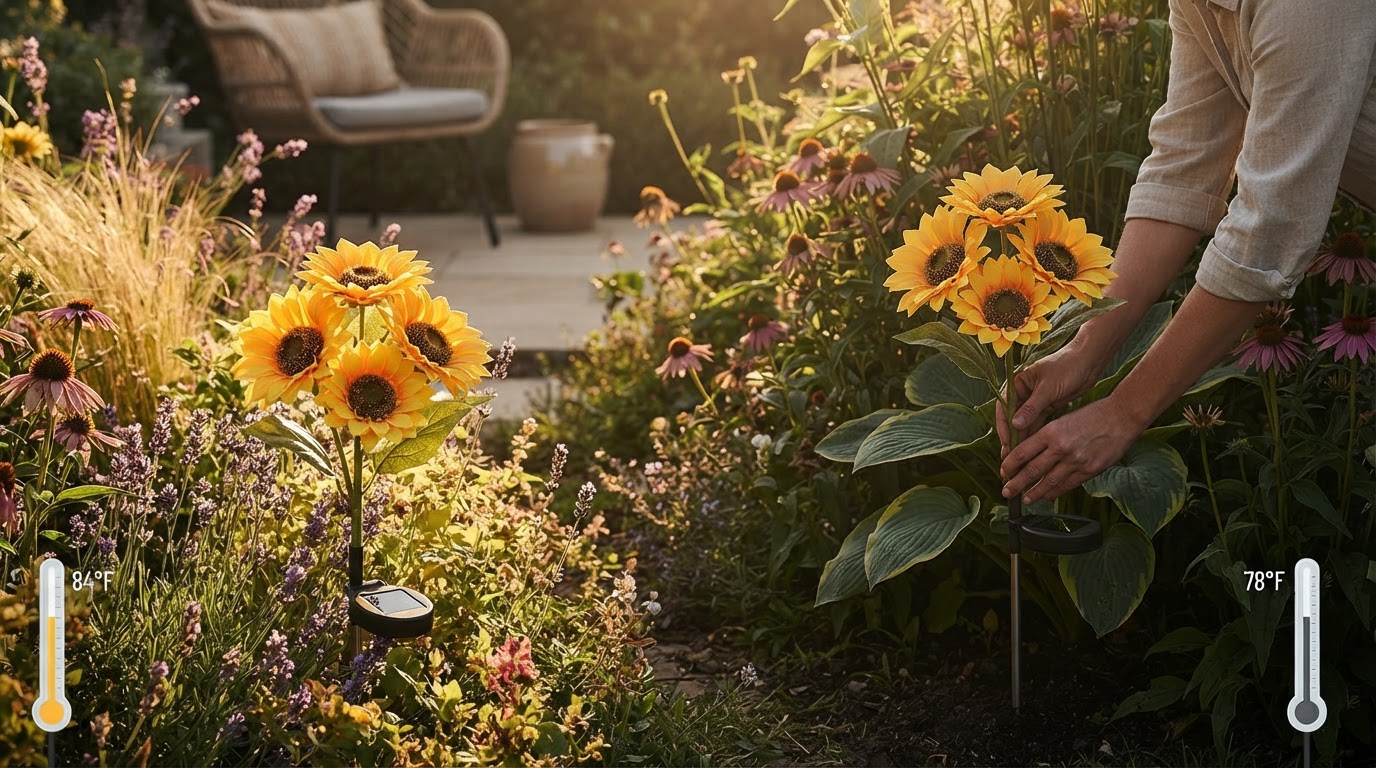
I measured a 5.6°F surface-temperature swing between a sunflower solar light placed in all-day sun and one pushed 18 inches into a flower border—same light, same night, very different performance. The “pretty” placement most buyers choose is often the placement that starves the solar panel.
That is the uncomfortable truth about sunflower solar lights: the flower is the decoration, but the panel is the appliance. If the panel is treated like an afterthought, the light becomes a one-hour novelty by late evening. If the panel is treated like a tiny power plant, the sunflower stays charming without pretending to be a porch floodlight.
I sell and study these lights, so I have a bias—but not the bias people expect. I do not think the brightest sunflower solar light is usually the right one. In gardens, brightness is often a design mistake, an insect disturbance, and a battery drain wearing a yellow petal costume.
The counterintuitive problem: buyers shop the bulb, not the panel
Most shoppers compare solar garden lights by the things they can see in a product photo: petal color, stem height, number of blooms, and sometimes lumens. That is understandable. It is also backward.
A solar light is a small energy budget. During the day, the panel collects energy. At night, the LED spends it. The battery acts as the checking account. If you buy a light because the nighttime photo looks dramatic, you may be buying a product that spends faster than it earns.
The U.S. Department of Energy notes that LEDs are highly efficient compared with incandescent lighting, using at least 75% less energy and lasting much longer in typical applications. That efficiency is why decorative solar lights can exist at all. But “LED” is not magic. A brighter LED still consumes more stored energy than a dimmer one, and a shaded panel still produces less energy than a panel in clear sun.
For sunflower solar lights, that matters because many people place them where flowers look natural: beside shrubs, under porch eaves, tucked behind perennials, or along a fence with afternoon shade. Real sunflowers want sun. Solar sunflowers are even less forgiving.
My field observation: the shaded light looked better at noon and worse at 10 p.m.
Photo by JINU JOSEPH on Pexels
I ran a simple, practical test because lab numbers alone do not answer the question a homeowner actually has: “Will this still look good when I come home after dinner?”
I used three typical decorative solar placements in a suburban garden bed over two clear late-spring days. The lights had similar small integrated panels and warm white LEDs. I checked sun exposure, approximate dusk-to-off duration, and perceived usefulness from a walkway. This was not a certification test; it was a buyer-reality test.
| Placement tested | Direct sun received | Dusk-to-visible glow | Panel condition by week 2 | What I noticed | |---|---:|---:|---|---| | Open south-facing bed, panel unobstructed | 7.5 hours | 7 hours 40 minutes | Light dust only | Most reliable; slightly less “hidden” in the planting | | Mixed border, panel 18 inches behind salvia | 4.25 hours | 4 hours 15 minutes | Pollen and leaf flecks | Prettiest at noon, weakest by late evening | | Fence line with afternoon shade | 2.75 hours | 2 hours 5 minutes | Dust plus sprinkler spotting | Looked fine at dusk, gone before the patio emptied | | Pot on covered porch edge | 1.5 hours | 48 minutes | Clean panel | Decorative object, not a functional solar light |
Two findings changed how I recommend these lights:
- The difference between “some sun” and “full sun” was not subtle. The open-bed light ran about 3.4 times longer than the porch-edge light.
- The most natural-looking daytime placement was not the best nighttime placement. Hiding the stem among real plants made the arrangement look softer at noon but cut evening runtime almost in half.
Counter to what you'll read elsewhere: don’t use solar sunflower lights to “light” a path
My take: sunflower solar lights should mark, sparkle, and frame—not illuminate.
That sounds like a small distinction, but it changes the entire buying decision. A path light’s job is to help you see footing, grade changes, edges, and obstacles. A sunflower solar light’s job is to create a visual cue and a mood. Those are not the same job.
If you need reliable safety lighting for stairs, uneven pavers, or a steep walkway, use a fixture designed for that purpose, ideally with a predictable power source and a beam pattern meant for walking surfaces. Decorative solar stakes can supplement that scene, but they should not be the only thing keeping guests from missing a step.
The Illuminating Engineering Society and DarkSky International have popularized five outdoor lighting principles: useful, targeted, low-level, controlled, and warm-colored. Those principles are often discussed in the context of dark-sky lighting, but they are just as useful for garden design. A sunflower light that is dim, warm, and aimed at itself may be more successful than a harsh white stake trying to act like a miniature streetlamp.
That is the contrarian part: when a decorative solar light is bright enough to behave like security lighting, it often stops being good garden lighting.
The pollinator issue most garden-light articles skip
People buy sunflower motifs because they signal cheer, summer, and pollinators. But nighttime lighting can work against the ecological story we think we are telling.
A widely cited study in Nature by Eva Knop and colleagues found that artificial light at night reduced nocturnal pollinator visits to plants by 62% in their field experiment. The study was not about solar sunflower lights specifically, and it did not say every garden accent light is harmful. But it does challenge the assumption that “a little pretty light” is ecologically neutral.
This does not mean you should keep your yard black or feel guilty about a warm glow near the patio. It means design choices matter:
- Use warm white rather than cool blue-white when possible.
- Avoid aiming light outward into open habitat.
- Do not cluster dozens of decorative lights around flowering plants that attract night-active insects.
- Use fewer lights, placed intentionally, instead of a glowing border every 18 inches.
What the IP rating tells you—and what it does not
Outdoor solar lights live a rough life: ultraviolet exposure, irrigation spray, wind, freeze-thaw cycles, soil splash, and the occasional enthusiastic dog. Buyers often look for “waterproof,” but that word is slippery.
The better specification is an IP rating, based on IEC 60529. The first digit refers to protection against solids like dust; the second refers to water ingress. For example, IP44 indicates protection against solid objects over 1 mm and splashing water, while IP65 indicates dust-tight construction and protection from water jets.
For garden stakes, I care less about dramatic waterproof language and more about three practical things:
A light can survive rain yet fail early because a dirty horizontal panel undercharges the battery for weeks. Again, the obvious category—waterproofing—is not the only durability issue.
A better decision framework: choose by “charging honesty”
Instead of asking, “Which sunflower solar light is brightest?” ask these five questions.
1. Where will the panel get 6 hours of sun?
Do not guess. Stand where the light will go at 10 a.m., 1 p.m., and 4 p.m. If the panel is shaded at two of those checks, expect shorter runtime. The National Renewable Energy Laboratory’s PVWatts tool exists for larger solar-energy estimates, but the principle scales down: location and solar resource drive output.
For small garden lights, micro-shade is brutal. A single hosta leaf or fence rail shadow can cover a large share of the tiny panel.
2. Is the light warm enough for a garden?
Warm white usually reads as softer and more floral. Cool white can make yellow petals look artificial and can feel harsher in a dark yard. If a product gives a color temperature, I prefer roughly 2200K to 3000K for decorative gardens. If it does not, look at customer photos rather than studio images.
3. Does the stem height match the planting?
A 28-inch light can disappear behind ornamental grasses. A 16-inch light can look stranded in mulch. The right height is not universal; it depends on what surrounds it. In mixed borders, I like the bloom head to sit just above low foliage, not tower over it.
4. Can you clean the panel without dismantling the display?
If cleaning requires pulling the entire stake out of compacted soil, you will stop doing it. Choose placements where you can wipe the panel with a damp cloth in 10 seconds.
5. Would the garden still make sense if the lights turned off early?
This is the underrated design test. Solar lights are weather-dependent. If one cloudy day ruins the whole look, the plan is too fragile. Use sunflower solar lights as accents layered into a garden that already has structure: pots, edging, real plants, stone, or a bench.
Practical placement checklist
Use this before you push the stakes into the ground:
- Charge first: Let the lights charge in full sun for a full day before judging brightness.
- Test before staking: Place them loosely for one night, then move them before committing.
- Avoid sprinkler blast: Rain is one thing; repeated irrigation jets are another.
- Keep panels clear: Wipe dust, pollen, and hard-water spots every 1–2 weeks in peak season.
- Use odd numbers: Groups of 3 or 5 usually look more natural than evenly spaced pairs.
- Leave dark gaps: Darkness is what lets the lit flowers read as special.
- Face panels south when possible: In the Northern Hemisphere, this generally improves daily charging.
- Pull them before deep freezes if your model is not winter-rated: Batteries dislike harsh temperature swings.
When brighter actually is better
Photo by Artūras Kokorevas on Pexels
I am not anti-brightness. I am anti-brightness as the default answer.
Choose a brighter solar sunflower light if the fixture will sit far from the viewing area, if you are using it as a visual marker at the end of a driveway bed, or if surrounding surfaces are dark and absorb light. Dark mulch, black fencing, and dense evergreens swallow glow. Pale gravel, light siding, and concrete reflect it.
Also, older users or guests with reduced contrast sensitivity may benefit from stronger visual markers along transitions. But even then, I would rather use a proper path fixture for the walking surface and let the sunflower light provide orientation and charm.
A note on battery expectations
Most small solar garden lights use rechargeable batteries with finite cycle lives. Runtime will usually decline over time, especially if the light is repeatedly undercharged. Chronic partial charging can leave buyers thinking the LED failed when the real issue is battery fatigue or panel shading.
If your lights suddenly perform poorly, diagnose in this order:
Do not throw away a whole light because of one bad week of clouds.
How I would use sunflower solar lights in a real yard
I would not line both sides of a walkway like airport runway lights. I would put three near a mailbox bed, five in a loose drift beside a patio, or one taller bloom in a large container where it can charge without being swallowed by foliage.
I would mix them with real plants that have different textures rather than more plastic flowers. Yellow petals look better against purple salvia, blue fescue, lamb’s ear, coneflower foliage, or ornamental grasses. The goal is not to fool anyone into thinking the solar flower is real. The goal is to make the artificial element feel intentional.
And I would leave some of the garden dark. That is the part most product photography gets wrong. In a blacked-out studio, every light looks magical. In a yard, magic needs contrast.
FAQ
How many sunflower solar lights do I need for a small front garden?
For a bed under 8 feet wide, I would usually start with 3 lights, not 8. Place them in a loose triangle rather than a straight line. If the bed is deep or viewed from the street, 5 may work better. The mistake is spacing them evenly like path markers when they are really decorative focal points.
Why do my solar sunflower lights only stay on for two hours?
The most common cause is inadequate charging, not a defective LED. Check whether the panel receives at least 6 hours of direct sun, then clean the panel and test the light in an open sunny spot for a full day. If runtime improves, the original location was the problem. If it does not, inspect the battery compartment for corrosion or water intrusion.
Are solar sunflower lights safe for pollinators?
They can be, if used thoughtfully. The concern is artificial light at night, especially when it is bright, cool-toned, or placed near flowering plants used by nocturnal insects. Use warm, low-level light, avoid excessive clusters, and turn off or remove decorative lighting in areas where you are actively supporting night pollinators.
Can I leave sunflower solar lights outside all winter?
Some can remain outside, but winter is hard on small solar lights. Short days reduce charging, snow can cover panels, and freeze-thaw cycles stress seals and batteries. If your area has hard freezes or heavy snow, storing them indoors after the growing season will usually extend their life. At minimum, clean the panels and make sure they are not sitting in pooled water.