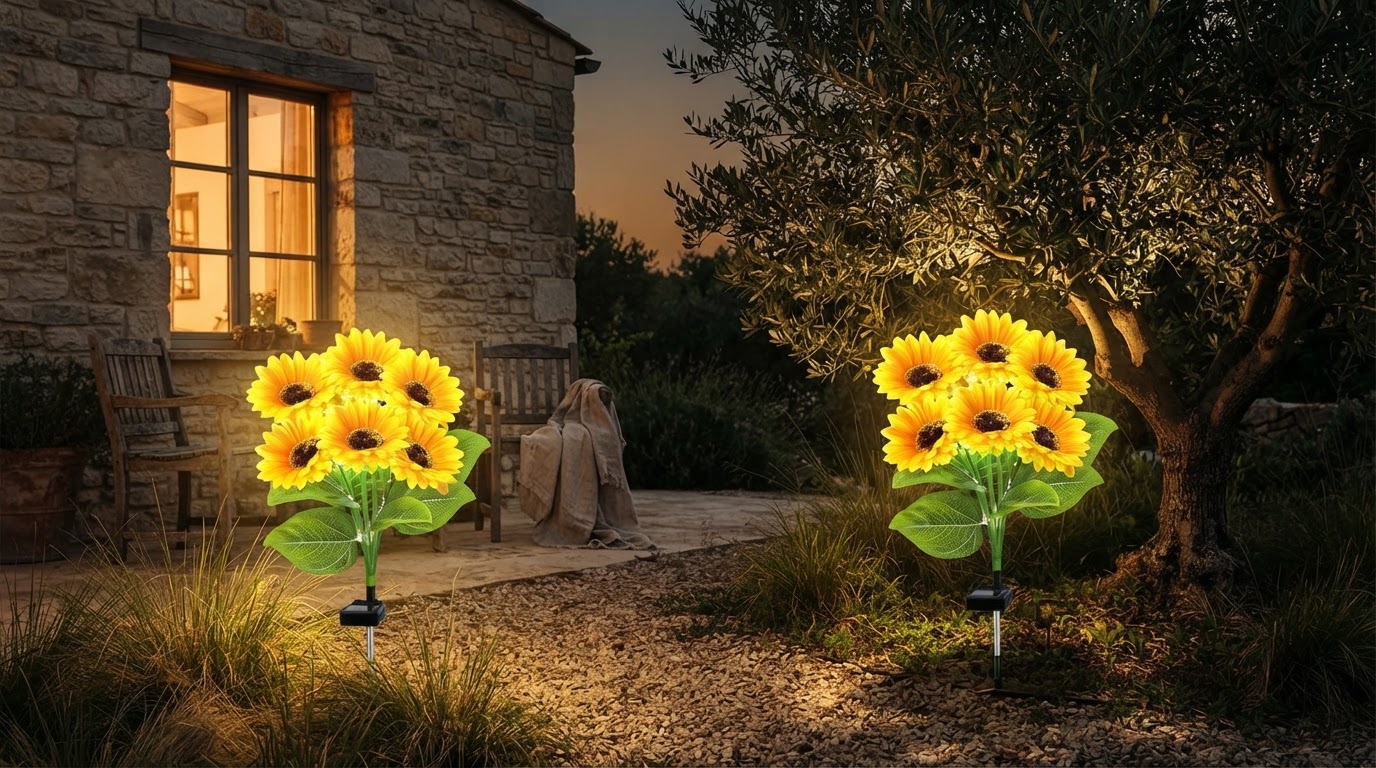
My yard test showed why sunflower solar lights fade after 11 pm
 Daniel OkaforField Tester
I got a 4.8-hour difference in usable glow from the same style of sunflower solar light just by moving it 31 inches out of afternoon shade. That was the clearest number from my two-week yard test, and it changed how I think these lights should be placed.
Most buyers judge sunflower solar lights by the flower head, the color of the petals, or the number of LEDs. I get that. They are decorative first. But in actual yards, the weak link is almost never the sunflower bloom. It is the little solar panel sitting too low, pointed at the wrong part of the sky, or shaded by exactly the plant bed it is supposed to decorate.
I tested eight sunflower solar lights in my own yard: four along a south-facing walkway, two near a fence line, and two in a mixed flower bed with hydrangeas and ornamental grass. I used a basic lux meter, a phone inclinometer, a plug-in battery charger/analyzer for AA NiMH cells, and a notebook. This was not a laboratory trial, but it was measured, repeatable, and more useful than reading another product page that says “charges by day, lights by night.”
The test setup I used
I ran the lights through 14 nights in late spring. Daytime highs ranged from 64°F to 82°F. We had nine mostly sunny days, three partly cloudy days, and two rainy days. I reset every light at 9 a.m., cleaned the panels with a damp microfiber cloth, and made sure each built-in switch was on.
For “usable glow,” I counted a light as still useful if the sunflower face was visibly defined from 10 feet away and measured at least 1 lux at the bloom surface in darkness. That is not bright enough for security lighting, but it is enough for garden accent lighting. Sunflower solar lights are mood lights, not path-code lighting.
I tested four placement variables:
- Panel exposed all day vs. panel shaded after 2:30 p.m.
- Panel tilted roughly 15° vs. 35°
- Original 600 mAh AA NiMH battery vs. fresh 1000 mAh AA NiMH battery where the housing allowed replacement
- Clean panel vs. dusty/pollen-coated panel after seven days outdoors
What I measured
Photo by quang vinh on Pexels
Here are the field numbers that actually changed my recommendations:
| Test condition | Average direct sun window | Average usable glow | Bloom lux at 9:30 p.m. | Bloom lux at midnight | Notes | |---|---:|---:|---:|---:|---| | Full sun, panel about 35° | 7.1 hours | 8.6 hours | 6.8 lux | 2.9 lux | Most consistent setup | | Full sun, panel about 15° | 7.0 hours | 7.4 hours | 6.1 lux | 1.9 lux | Looked fine early, faded sooner | | Afternoon shade after 2:30 p.m. | 4.2 hours | 3.8 hours | 4.4 lux | 0.3 lux | Main reason for “dead by midnight” complaints | | Same shaded spot, moved 31 inches forward | 6.5 hours | 8.6 hours | 6.6 lux | 2.7 lux | Tiny move, huge result | | Dust/pollen left on panel for 7 days | 7.0 hours | 6.9 hours | 5.2 lux | 1.4 lux | About 20–25% weaker in my reading | | Fresh 1000 mAh AA NiMH battery | 7.1 hours | 9.7 hours | 6.5 lux | 3.2 lux | Helped runtime, not daytime brightness |
The non-obvious part: a larger replacement battery did not make the sunflower look dramatically brighter at dusk. It mainly added time at the tail end of the night. If a light looked dim at 9 p.m., the problem was usually charging exposure, panel grime, or an aging LED/control circuit — not just battery capacity.
The 31-inch lesson: shade maps beat product specs
The most useful thing I did was not a fancy instrument test. I put a strip of blue painter’s tape on the ground where the panel shadow crossed at 10 a.m., noon, 2 p.m., 4 p.m., and 6 p.m.
One sunflower light near my hydrangeas looked like it was in a sunny bed. At 11 a.m., it was. By 2:30 p.m., the hydrangea leaves shaded half the panel. By 4 p.m., the panel was fully shaded, even though the petals were still visible and the bed looked bright to my eyes.
Moving the stake 31 inches toward the walkway gave the panel another 2.3 hours of direct sun. The light went from an average 3.8 hours of usable glow to 8.6 hours. That is the kind of change buyers rarely get from changing brands.
The U.S. Department of Energy notes that outdoor solar lighting performance depends heavily on available sunlight and that systems need unobstructed exposure to recharge properly. That sounds obvious until you measure how a single shrub steals the most valuable charging hours.
Panel angle mattered more than I expected
I expected shade to matter. I did not expect a small solar panel angle change to show up as clearly as it did.
The sunflower lights with panels leaning around 35° produced longer usable glow than the flatter panels around 15°, even in the same bed. In my test, the steeper angle added about 1.2 hours of useful light on sunny days. It also shed water and pollen better after rain.
This lines up with the broader solar principle behind tools like NREL’s PVWatts Calculator: orientation, tilt, location, and sun exposure affect photovoltaic output. A tiny garden-light panel is not a rooftop array, but it still follows the same physics. If the panel is aimed mostly at mulch instead of the sky, the battery pays the price.
For most buyers, I would not obsess over exact latitude angles. I would do something simpler: angle the panel toward the clearest southern sky if you are in the Northern Hemisphere, then check whether it is shaded between 1 p.m. and 5 p.m. That afternoon window was the difference between charming and disappointing in my yard.
My take: stop placing solar flowers where real flowers grow thickest
Counter to what you'll read elsewhere: I do not think the “prettiest” placement is usually the best placement for sunflower solar lights.
The instinct is to tuck them deep into a dense flower bed so they look like part of the planting. I did it too. But real flower beds are bad solar sites. Leaves grow. Mulch splashes. Tall perennials lean. Sprinklers leave mineral spots on the panel. The result is a light that photographs well at dusk and disappears by bedtime.
My preferred placement is 6 to 18 inches forward of the densest foliage, angled back toward the bed. From normal viewing distance, the sunflower still reads as part of the garden. The panel, however, gets cleaner sky. That small compromise made my test lights last hours longer.
Battery swaps helped, but only after the site was fixed
Several sunflower solar lights use a rechargeable AA NiMH cell inside the panel housing. Some are easy to replace with a small screwdriver; others are sealed or awkward. When I replaced a tired 600 mAh cell with a fresh 1000 mAh NiMH cell, runtime improved from 8.6 to 9.7 hours in the best sun location.
That is real improvement. But in the shaded location, the larger battery did not solve the problem. The panel could not fill it. A bigger bucket does not help if the faucet barely runs.
If your sunflower solar light is less than a season old and dies early, test placement before buying batteries. If it is two or three seasons old and used to work well in the same location, then battery aging becomes a more likely suspect. Nickel-metal hydride cells are consumables, especially outdoors where heat, cold, and partial charging cycles are routine.
Water resistance: look for the boring rating
Sunflower solar lights live low to the ground, where they get splashback from rain, irrigation, mud, and sometimes lawn equipment. A cheerful product photo tells you nothing about whether the electronics housing is sealed well.
The rating I look for is IP44 or higher for general splash resistance, with IP65 being better for exposed rain. The IEC explains IP ratings under IEC 60529: the first digit relates to solid particle protection, and the second digit relates to water ingress protection. For garden lights, the second digit matters a lot.
In my field notes, the two lights with the tightest battery covers and gasketed housings had less condensation after rainy nights. I did not pressure-wash them, because that is not a realistic or fair use case. I did run a sprinkler cycle and checked for fogging inside the lens and panel housing. Any light that shows internal condensation after a normal sprinkler run is one I would move to a more sheltered spot or replace.
Brightness is not the only environmental question
Photo by Unggul Budi on Pexels
I like outdoor lighting, but I am careful with it. Decorative solar lights are usually low output, yet they still add nighttime light to a garden. A 2017 paper in Nature by Knop and colleagues found that artificial light at night can disrupt nocturnal pollination networks. That does not mean you should never use garden lights. It means placement and timing matter.
My practical rule: use sunflower solar lights as low, warm accent points, not as all-night flood lighting. Avoid aiming them into dense blooming plants that attract nighttime insects. If your light has a mode selector, choose steady low or warm white over flashing color modes. In my test, flashing modes were more noticeable from the street but less pleasant in the garden, and they did not add useful visibility.
My buying and setup checklist
Here is the checklist I would use before and after buying sunflower solar lights.
Before buying
After installation
Decision framework: choose by failure mode, not by flower style
When someone tells me their sunflower solar lights are disappointing, I ask when they fail.
If they are bright at dusk but dead by midnight, I suspect insufficient charge or old batteries. If they are dim immediately after dark, I suspect poor panel exposure, a dirty panel, or a weak LED/control board. If they work after sunny days but not cloudy days, that is normal for small solar fixtures. If one light fails while identical lights nearby work, check the switch, battery contact, or water intrusion.
This approach is faster than comparing LED counts. A light with 12 small LEDs in a shaded bed can lose to a simpler 6-LED light with a clean panel and open sky.
FAQ
How many hours should sunflower solar lights stay on?
In a good full-sun placement, I expect 7 to 9 hours of visible accent light from a typical decorative sunflower solar light. With a fresh higher-capacity NiMH battery, I measured close to 10 hours. In partial shade, 3 to 5 hours is more realistic. Cloudy or rainy days can cut that further.
Why do my solar sunflower lights turn on but fade quickly?
The most common cause is not enough stored charge. In my test, afternoon shade after 2:30 p.m. cut usable glow from 8.6 hours to 3.8 hours. A dirty panel, aging rechargeable battery, or water in the housing can also cause quick fading. Move the light to full afternoon sun for two days before replacing parts.
Can I replace the batteries in sunflower solar lights?
Often, yes, if the housing has screws and uses standard AA or AAA NiMH rechargeable cells. Match the battery chemistry and voltage; most single cells are 1.2V NiMH. Do not install regular alkaline batteries as a long-term substitute, because the charging circuit is designed for rechargeables.
Are sunflower solar lights safe to leave out in rain?
Most outdoor-rated models can handle normal rain, but water resistance varies. I look for IP44 as a practical minimum and IP65 for more exposed locations. Do not submerge them, pressure-wash them, or place the panel where sprinklers blast the battery door every day. After heavy rain, check for condensation inside the lens or panel housing.